


Introduction
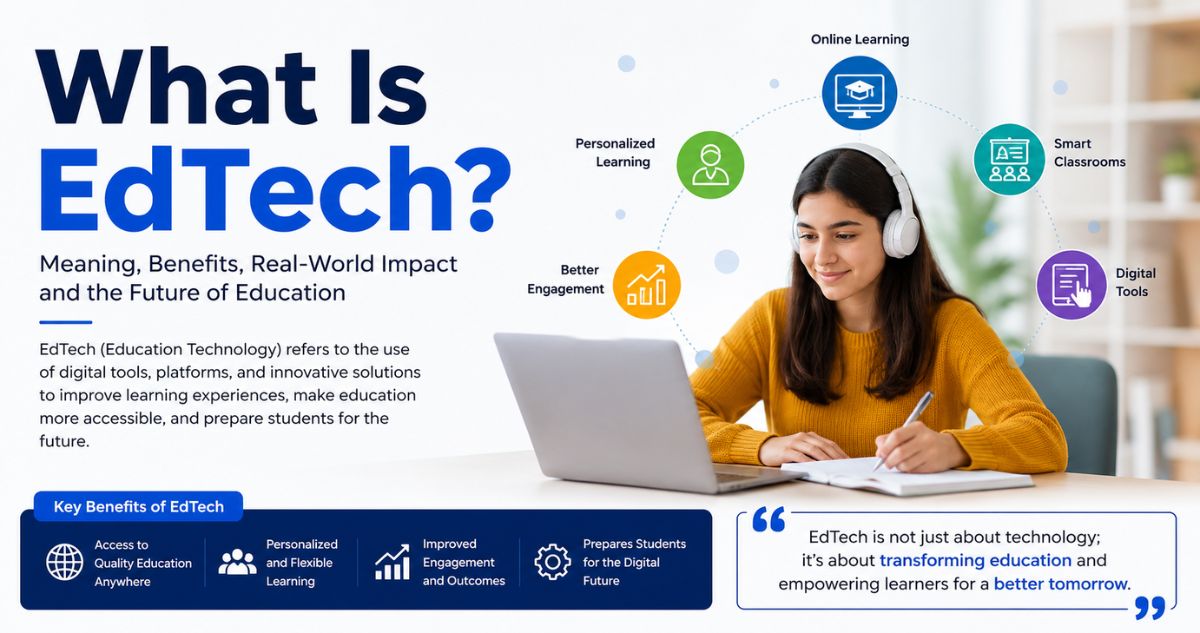
Education has always evolved alongside human progress, but few developments have transformed learning as dramatically as technology. Today, classrooms are no longer limited to physical spaces, textbooks are increasingly digital, and students can access high-quality learning materials from almost anywhere in the world. This transformation is known as Educational Technology, commonly referred to as EdTech.
EdTech combines education with digital innovation to improve how people teach, learn, communicate, and develop new skills. It includes everything from online learning platforms and virtual classrooms to artificial intelligence-powered tutoring systems, educational mobile applications, interactive whiteboards, and virtual reality learning experiences.
The growing availability of high-speed internet, cloud computing, smartphones, and intelligent software has made learning more accessible than ever before. Students can attend live classes remotely, complete assignments online, collaborate with classmates across different countries, and receive personalized learning recommendations based on their individual progress. Teachers also benefit from powerful digital tools that simplify lesson planning, student assessment, classroom management, and communication.
Educational technology is not limited to schools and universities. Businesses use EdTech platforms to train employees, healthcare organizations educate medical professionals through virtual simulations, and governments use digital learning systems to expand educational opportunities. As lifelong learning becomes increasingly important in today’s rapidly changing world, EdTech continues to play a vital role in helping people gain new knowledge and develop valuable skills.
Whether you are a student, teacher, parent, business owner, or lifelong learner, understanding EdTech is essential in today’s digital age. This comprehensive guide explains what EdTech is, how it works, why it matters, its major types, benefits, challenges, and the future of educational technology.
Latest Updates in EdTech
Educational technology continues to evolve rapidly as new innovations reshape how knowledge is delivered and consumed. Some of the most significant developments include:
Artificial Intelligence in Education
AI-powered learning assistants can answer questions, explain complex topics, generate quizzes, summarize lessons, and personalize study plans according to each learner’s strengths and weaknesses.
Adaptive Learning Platforms
Modern learning systems automatically adjust lesson difficulty based on student performance, helping learners progress at their own pace without unnecessary repetition.
Hybrid Learning Models
Many educational institutions now combine traditional classroom teaching with online learning resources, offering greater flexibility while maintaining face-to-face interaction.
Virtual and Augmented Reality
VR and AR technologies create immersive educational experiences where students can explore historical locations, conduct virtual science experiments, or practice medical procedures in realistic digital environments.
Learning Analytics
Advanced analytics help teachers monitor attendance, engagement, assignment completion, and academic performance, enabling earlier intervention when students require additional support.
Mobile Learning
Smartphones and tablets have become essential educational tools, allowing learners to access lessons, videos, quizzes, and digital libraries anytime and anywhere.
Why Is EdTech Important?
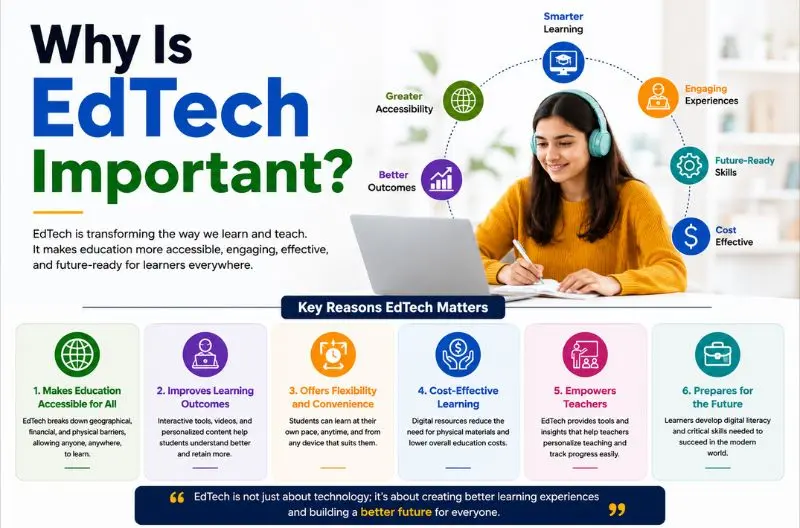
Educational technology has become one of the most influential forces in modern education because it removes traditional barriers to learning and creates more opportunities for students worldwide.
Some of the biggest reasons EdTech is important include:
- Makes quality education accessible regardless of geographical location.
- Supports flexible learning schedules for students and working professionals.
- Encourages interactive and engaging classroom experiences.
- Personalizes learning according to individual progress.
- Improves collaboration between teachers and students.
- Simplifies assignment submission, grading, and feedback.
- Enhances student engagement through multimedia learning.
- Reduces dependence on printed educational materials.
- Supports lifelong learning and continuous professional development.
- Helps educational institutions efficiently manage courses and student records.
How Does EdTech Work?
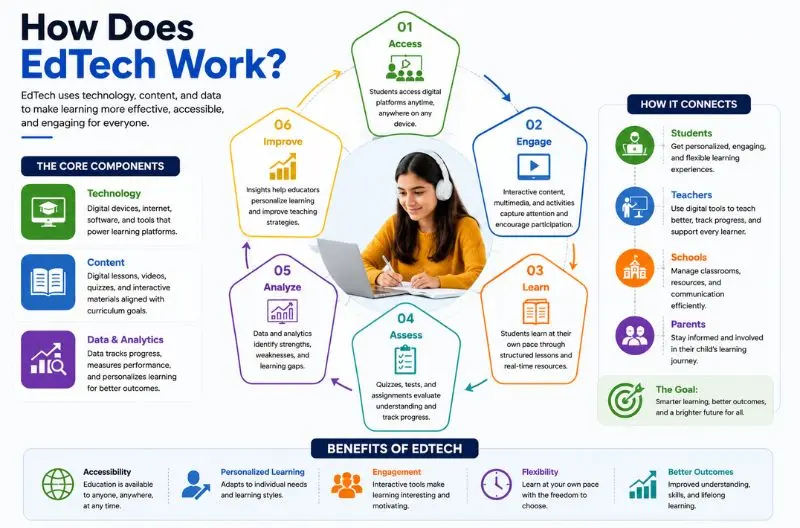
EdTech integrates digital technologies into the learning process to improve teaching, learning, communication, and assessment. Rather than relying solely on traditional classroom instruction, educational technology creates interactive and flexible learning environments where students can access resources anytime and anywhere.
A typical EdTech system works through several key steps:
- Content Creation: Teachers or organizations develop digital lessons, videos, quizzes, presentations, and assignments.
- Content Delivery: The materials are uploaded to a learning platform where students can access them using a computer, tablet, or smartphone.
- Interactive Learning: Students participate through live classes, recorded lectures, discussion forums, simulations, and educational games.
- Assessment: Online quizzes, assignments, and exams measure student understanding and provide immediate feedback.
- Analytics: Learning platforms collect data on attendance, progress, completion rates, and performance, helping educators identify strengths and areas for improvement.
This digital workflow makes learning more efficient, measurable, and personalized.
Major Types of EdTech
Educational technology covers many different tools and learning environments. Each serves a specific purpose in improving education.
1. Learning Management Systems (LMS)
A Learning Management System is software used to organize, deliver, and manage educational courses. Teachers can upload lessons, assign homework, track progress, and communicate with students through one platform.
Common uses include:
- Course management
- Assignment submission
- Online grading
- Student progress tracking
- Discussion forums
2. Virtual Classrooms
Virtual classrooms allow teachers and students to meet online in real time using video conferencing technology.
Features often include:
- Live video lessons
- Screen sharing
- Digital whiteboards
- Chat and discussions
- Attendance tracking
- Session recording
Virtual classrooms became especially important during periods of remote learning and continue to support hybrid education models.
3. Mobile Learning (mLearning)
Mobile learning allows students to study using smartphones and tablets. Educational apps provide access to lessons, quizzes, videos, flashcards, and practice exercises from virtually anywhere.
Benefits include:
- Learning on the go
- Flexible study schedules
- Short, focused lessons
- Offline learning options in many apps
4. Artificial Intelligence (AI) in Education
Artificial intelligence is transforming education by making learning more personalized and efficient.
AI can:
- Recommend learning materials
- Answer student questions
- Generate practice exercises
- Provide instant feedback
- Identify learning gaps
- Personalize study plans
AI supports teachers by automating repetitive tasks while helping students receive individualized guidance.
5. Virtual Reality (VR) and Augmented Reality (AR)
VR and AR provide immersive learning experiences that make complex concepts easier to understand.
Examples include:
- Exploring ancient civilizations through virtual tours
- Practicing laboratory experiments safely
- Medical training simulations
- Engineering design visualization
- Interactive science education
These technologies improve engagement by allowing students to learn through experience rather than observation alone.
6. Gamified Learning
Gamification uses game elements to motivate learners.
Common features include:
- Points
- Badges
- Levels
- Leaderboards
- Rewards
- Challenges
Gamified learning encourages participation and helps increase motivation and knowledge retention.
Key Features of EdTech
Modern educational technology platforms often include:
- Cloud-based learning
- Interactive multimedia lessons
- Live and recorded classes
- Digital assignments
- Automated assessments
- Instant feedback
- Collaboration tools
- Discussion forums
- Student analytics
- Progress tracking
- Mobile accessibility
- AI-powered recommendations
- Secure data storage
- Personalized learning paths
History of EdTech
The evolution of educational technology reflects advances in communication and computing.
| Period | Major Development |
|---|---|
| Early 1900s | Film projectors and educational radio |
| 1950s–1970s | Television-based education |
| 1980s | Personal computers entered classrooms |
| 1990s | Internet-based learning emerged |
| 2000s | Learning Management Systems became common |
| 2010s | Smartphones and cloud learning expanded rapidly |
| 2020s | AI, hybrid learning, VR, and adaptive learning became mainstream |
Each stage has expanded access to education while improving the quality of teaching and learning.
Real-World Applications of EdTech
Educational technology is used across many sectors, including:
Schools
- Smart classrooms
- Digital textbooks
- Homework portals
- Student assessments
Universities
- Online degree programs
- Research collaboration
- Virtual laboratories
- Digital libraries
Businesses
- Employee onboarding
- Compliance training
- Professional certification
- Skills development
Healthcare
- Medical simulations
- Continuing medical education
- Virtual patient training
Government
- Public education initiatives
- Distance learning programs
- Teacher training
- Digital literacy campaigns
Traditional Learning vs EdTech
| Feature | Traditional Learning | EdTech |
| Learning Location | Physical classroom | Anywhere with internet access |
| Schedule | Fixed | Flexible |
| Learning Pace | Same for everyone | Personalized |
| Resources | Printed books | Digital content |
| Feedback | Usually delayed | Often immediate |
| Collaboration | Face-to-face | Online and offline |
| Assessments | Paper-based | Digital and automated |
| Accessibility | Limited by location | Global access |
Benefits of EdTech
Educational technology has transformed learning by making education more accessible, engaging, and efficient. Whether used in schools, universities, workplaces, or for self-paced learning, EdTech offers numerous advantages for learners and educators alike.
1. Greater Accessibility
Students can access educational content from almost anywhere with an internet connection. This helps learners in remote areas and supports people who cannot attend traditional classrooms.
2. Personalized Learning
Many EdTech platforms adapt lessons based on a learner’s progress, allowing students to move at their own pace and focus on areas where they need improvement.
3. Increased Engagement
Interactive videos, quizzes, simulations, and gamified lessons make learning more enjoyable and help improve knowledge retention.
4. Flexible Learning
Learners can study according to their own schedules, making education more convenient for working professionals, parents, and lifelong learners.
5. Better Collaboration
Discussion forums, shared documents, video conferencing, and collaborative projects make it easier for students and teachers to communicate and work together.
6. Faster Assessment
Digital quizzes and automated grading provide immediate feedback, allowing students to identify mistakes quickly and improve their understanding.
7. Cost Efficiency
Many online courses and digital resources are more affordable than traditional classroom programs, reducing expenses for travel, printed materials, and infrastructure.
Risks and Disadvantages of EdTech
While EdTech offers many benefits, it also presents certain challenges.
Common Myths About EdTech
Myth 1: EdTech Will Replace Teachers
Reality: Technology is designed to support educators, not replace them. Teachers remain essential for guidance, mentoring, assessment, and classroom management.
Myth 2: Online Learning Is Easier Than Classroom Learning
Reality: High-quality online learning often requires strong time management, consistent participation, and active engagement.
Myth 3: EdTech Is Only for Schools
Reality: Educational technology is widely used in universities, businesses, healthcare, government agencies, and professional training programs.
Myth 4: Expensive Technology Always Produces Better Learning
Reality: Effective teaching strategies and well-designed learning experiences matter more than expensive hardware.
Hidden Details and Bonus Information
Many people associate EdTech only with online classes, but the field extends much further.
Some lesser-known facts include:
- Artificial intelligence can identify learning gaps and recommend personalized study materials.
- Learning analytics help educators improve teaching methods through data-driven insights.
- Microlearning delivers information in short, focused lessons that fit busy schedules.
- Virtual laboratories allow students to conduct experiments safely in digital environments.
- Gamification increases learner motivation by incorporating rewards and challenges.
- Businesses increasingly use EdTech for employee onboarding, compliance training, and leadership development.
FAQs
What does EdTech stand for?
EdTech stands for Educational Technology, referring to the use of digital tools, software, and innovative teaching methods to improve learning experiences and educational outcomes.
Is EdTech only for schools?
No. EdTech is used in schools, universities, businesses, healthcare organizations, government agencies, and professional training programs.
What are some common examples of EdTech?
Examples include learning management systems, online learning platforms, educational mobile apps, virtual classrooms, AI tutoring tools, digital textbooks, and virtual reality learning experiences.
How does artificial intelligence improve EdTech?
AI can personalize learning, provide instant feedback, recommend study materials, automate grading, and help educators analyze student performance.
What skills are important in the EdTech industry?
Useful skills include digital literacy, instructional design, educational psychology, data analysis, software development, content creation, and user experience design.
Is EdTech the future of education?
EdTech is expected to play an increasingly important role in education by supporting personalized learning, improving accessibility, and integrating emerging technologies such as AI, virtual reality, and learning analytics.
Expert Tips for Getting the Most from EdTech
- Choose trusted learning platforms with high-quality educational content.
- Set clear learning goals before starting an online course.
- Maintain a consistent study schedule to stay motivated.
- Use interactive features such as quizzes and discussion forums.
- Combine digital learning with practical activities and real-world application.
- Regularly review your progress using analytics and feedback tools.
- Stay informed about new technologies and teaching methods to continue developing your skills.
Conclusion
Educational technology has fundamentally changed how knowledge is created, shared, and experienced. By combining innovative digital tools with effective teaching practices, EdTech enables learners to access education more easily, study at their own pace, and develop skills that are increasingly important in today’s technology-driven world.
From virtual classrooms and mobile learning applications to artificial intelligence and immersive virtual reality experiences, EdTech continues to expand the possibilities of education. It supports teachers by simplifying administrative tasks, helps institutions deliver flexible learning programs, and empowers students through personalized learning pathways that adapt to individual needs.
Despite challenges such as digital inequality, cybersecurity concerns, and the need for ongoing teacher training, the benefits of educational technology continue to outweigh its limitations. As internet access improves and emerging technologies become more sophisticated, EdTech is expected to play an even greater role in schools, universities, businesses, and lifelong learning initiatives worldwide.
Whether you are a student looking to improve your knowledge, an educator seeking innovative teaching methods, or an organization planning workforce training, understanding EdTech provides valuable insight into the future of education. By embracing educational technology responsibly and thoughtfully, learners and educators alike can create more engaging, inclusive, and effective learning experiences for years to come.
