


Introduction
Education has changed dramatically over the last decade. Today, learning is no longer limited to classrooms, expensive textbooks, or paid online courses. Thanks to the internet, students and self-learners can access thousands of high-quality educational resources without spending any money. Whether you want to improve your school grades, prepare for competitive exams, learn programming, develop creative skills, or simply expand your knowledge, countless free learning platforms are available to help you achieve your goals.
The Best Free Learning Resources for Students and Self-Learners make quality education accessible to everyone regardless of age, location, or financial situation. From video lessons and interactive quizzes to digital libraries, online courses, educational podcasts, and practice exercises, these resources provide flexible learning opportunities that fit different schedules and learning styles.
One of the biggest advantages of free learning resources is that they encourage lifelong learning. Students can strengthen classroom knowledge, while professionals can upgrade their skills to remain competitive in today’s fast-changing job market. Self-learners also benefit because they can explore new subjects at their own pace without the pressure of deadlines or tuition fees.
However, having unlimited resources also creates a challenge. With so many websites, apps, and online platforms available, choosing reliable and effective learning materials can become overwhelming. Some resources are excellent, while others may contain outdated or inaccurate information.
This guide explores the Best Free Learning Resources for Students and Self-Learners, explains why they are valuable, and provides practical advice for selecting the right platforms according to your educational goals. By the end of this article, you will know exactly where to find quality learning materials and how to make the most of them.
What is Best Free Learning Resources for Students and Self-Learners?
The Best Free Learning Resources for Students and Self-Learners are educational platforms, websites, mobile applications, digital libraries, video channels, and online communities that provide learning materials without requiring payment. These resources cover a wide range of subjects including mathematics, science, languages, business, technology, arts, personal development, and professional skills.
Unlike traditional education, these platforms allow learners to study anytime and anywhere. Most only require an internet connection and a computer, tablet, or smartphone.
Free learning resources come in different formats, including:
- Online video lectures
- Interactive practice exercises
- Digital textbooks
- Free eBooks
- Research articles
- Educational podcasts
- Virtual classrooms
- Coding practice websites
- Language learning applications
- Educational discussion forums
Some resources are designed specifically for school and college students, while others focus on career development or personal interests. This variety makes it easier for learners to choose materials that match their experience level and learning objectives.
Another important feature is flexibility. Learners can revisit lessons whenever necessary, pause videos, repeat difficult topics, and study according to their own schedules. This personalized approach often improves understanding and long-term knowledge retention.
Free learning resources also encourage independent thinking. Instead of relying entirely on teachers, learners develop research skills, critical thinking, and problem-solving abilities through self-directed education.
Why is Best Free Learning Resources for Students and Self-Learners Important?
Access to quality education should not depend on financial resources. Free educational platforms help reduce learning barriers and provide equal opportunities for everyone.
Here are several reasons why these resources have become essential.
- Makes Education Affordable
Many students cannot afford expensive courses or textbooks. Free educational platforms eliminate financial obstacles while providing access to high-quality learning materials.
This creates opportunities for learners from different backgrounds to improve their education without increasing expenses.
- Supports Flexible Learning
Unlike traditional classroom schedules, free learning platforms allow students to learn whenever they have available time.
Whether studying early in the morning, during lunch breaks, or late at night, learners can continue their education without strict schedules.
- Encourages Lifelong Learning
Learning does not stop after graduation.
Professionals frequently need new skills as industries evolve. Free resources help individuals stay updated with current trends, technologies, and workplace requirements throughout their careers.
- Improves Academic Performance
Students often need additional explanations beyond classroom teaching.
Free tutorials, practice questions, educational videos, and interactive exercises reinforce concepts and improve exam preparation.
Consistent practice usually leads to better grades and increased confidence.
- Develops Career Skills
Many employers value practical skills alongside academic qualifications.
Free learning resources teach valuable abilities such as:
- Programming
- Graphic design
- Data analysis
- Public speaking
- Project management
- Communication
- Digital marketing
- Writing
These skills strengthen resumes and increase job opportunities.
- Provides Global Learning Opportunities
Students can now learn from instructors and universities around the world.
Instead of depending only on local educational institutions, learners gain access to international teaching methods, diverse perspectives, and updated educational content.
- Promotes Independent Learning
Self-learning develops discipline, responsibility, and curiosity.
Instead of waiting for someone to explain every concept, learners actively search for answers, solve problems independently, and build confidence in their abilities.
These habits become valuable throughout academic and professional life.
- Offers Learning in Multiple Formats
People learn differently.
Some prefer videos, while others understand concepts better through reading, listening, or hands-on practice.
Free educational resources support different learning styles by providing:
- Video tutorials
- Articles
- Interactive quizzes
- Audio lessons
- Downloadable notes
- Practice assignments
This variety improves engagement and knowledge retention.
- Keeps Knowledge Updated
Educational content changes quickly, especially in technology, science, and business.
Many free platforms regularly update their materials, ensuring learners receive current information rather than outdated knowledge.
- Builds Confidence
Completing lessons, mastering new skills, and solving increasingly difficult problems gives learners a sense of achievement.
As confidence grows, students become more motivated to continue learning and pursue larger educational goals.
Step 1: Define Your Learning Goal

Before exploring the countless educational resources available online, identify exactly what you want to learn. Having a clear objective helps you choose the right materials and stay motivated throughout your learning journey.
Ask yourself a few simple questions:
- What subject do I want to study?
- Am I learning for school, work, or personal interest?
- How much time can I dedicate each week?
- What skill do I want to master?
For example, a college student preparing for mathematics exams will need different resources than someone learning graphic design or web development.
Specific goals also make it easier to measure progress. Instead of saying, “I want to learn English,” set a goal like, “I want to improve my English speaking skills within three months.”
Step 2: Choose Reliable Learning Resources
Not every free educational website offers high-quality content. Some contain outdated information or poorly organized lessons.
When selecting the Best Free Learning Resources for Students and Self-Learners, look for platforms that provide:
- Updated learning materials
- Qualified instructors
- Positive learner reviews
- Organized course structures
- Practice exercises
- Certificates (if available)
- Beginner-friendly explanations
Reliable resources usually explain topics step by step rather than assuming prior knowledge.
Step 3: Select the Right Learning Format
Everyone learns differently.
Some students absorb information by reading, while others understand concepts better through videos or interactive exercises.
Choose formats that match your learning style.
Reading Resources
These include:
- Digital textbooks
- eBooks
- Study notes
- Research papers
- Educational blogs
Reading improves concentration and helps learners understand complex concepts in greater detail.
Video Lessons
Video tutorials simplify difficult subjects by combining visual explanations with spoken instruction.
They are especially useful for:
- Mathematics
- Science
- Programming
- Graphic design
- Software tutorials
- Language learning
Many students find visual demonstrations easier to remember than written explanations.
Interactive Practice
Knowledge improves through practice.
Interactive resources often include:
- Quizzes
- Coding exercises
- Problem-solving activities
- Flashcards
- Mock tests
These tools provide immediate feedback, helping learners identify weak areas quickly.
Audio Learning
Podcasts and recorded lectures allow students to learn while commuting, exercising, or completing daily tasks.
Audio learning is particularly helpful for:
- Language practice
- History
- Business
- Personal development
It allows productive use of time that might otherwise be wasted.
Step 4: Create a Study Schedule
Consistency matters more than studying for long hours occasionally.
Instead of studying six hours once a week, aim for shorter daily sessions.
For example:
- Day Study Time Activity
- Monday 45 minutes Watch video lessons
- Tuesday 45 minutes Read notes
- Wednesday 60 minutes Practice exercises
- Thursday 45 minutes Revision
- Friday 60 minutes Complete quizzes
- Saturday 90 minutes Mini project
- Sunday 30 minutes Weekly review
Following a schedule builds discipline and prevents procrastination.
Step 5: Take Notes While Learning
Watching videos without writing anything often leads to poor retention.
Instead:
- Write key definitions.
- Highlight important formulas.
- Summarize each lesson.
- Create mind maps.
- Record difficult concepts.
Reviewing your own notes before exams is much easier than searching through hours of online videos.
Step 6: Practice What You Learn
Learning without application rarely produces lasting results.
For example:
If studying programming, build small projects.
If learning English, practice speaking daily.
If studying mathematics, solve additional questions.
If learning graphic design, create real designs.
Practical experience strengthens understanding far more than passive reading.
Step 7: Review Regularly
Forgetting information is normal.
Regular revision keeps knowledge fresh.
An effective review cycle may look like this:
- Review after one day.
- Review after one week.
- Review after one month.
- Review before examinations.
This approach significantly improves long-term memory.
Step 8: Track Your Progress
Monitoring improvement keeps motivation high.
You can track progress by:
- Completing weekly quizzes
- Recording study hours
- Finishing projects
- Keeping a learning journal
- Setting monthly milestones
Small achievements encourage learners to continue progressing.
Step 9: Join Learning Communities
Learning becomes easier when you connect with others.
Study communities allow students to:
- Ask questions
- Share notes
- Discuss difficult concepts
- Exchange ideas
- Receive encouragement
Collaborative learning often improves understanding while making education more enjoyable.
Step 10: Stay Consistent
Success comes from regular effort rather than perfection.
Some days you may only have twenty minutes available.
That’s perfectly acceptable.
Small daily improvements eventually produce significant results over time.
Avoid comparing your progress with others.
Focus on becoming better than you were yesterday.
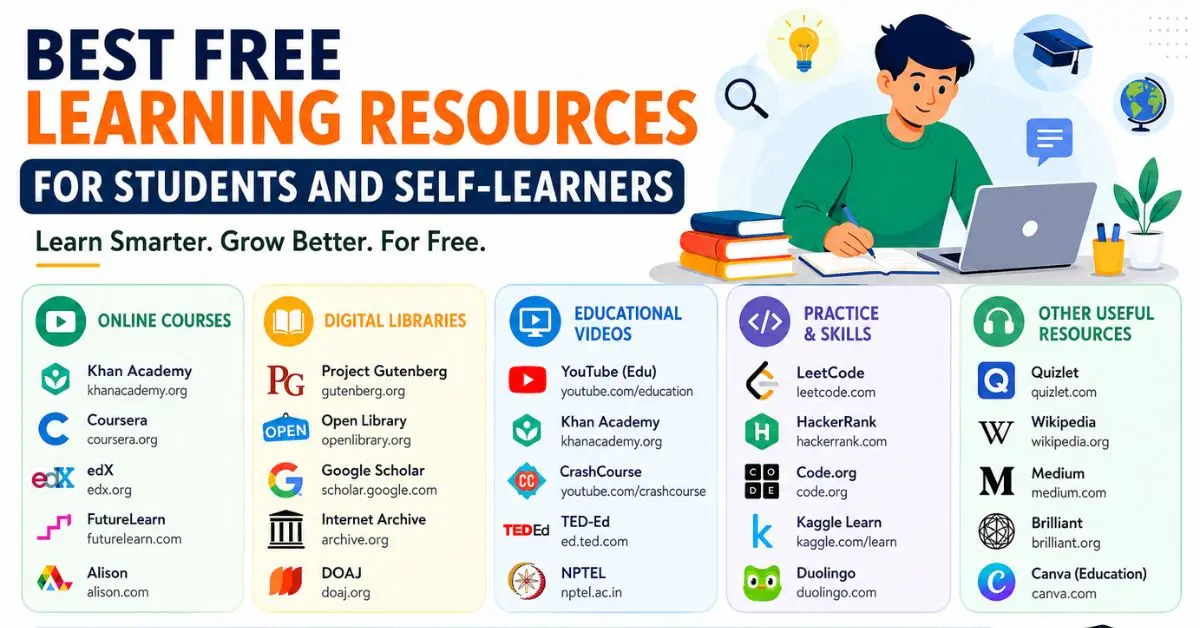
Examples of Excellent Free Learning Resources
Although there are thousands of educational platforms available, the following categories are among the most useful.
Online Course Platforms
These offer structured lessons covering academic and professional subjects.
They often include:
- Video lectures
- Assignments
- Quizzes
- Completion certificates
- Digital Libraries
Digital libraries provide free access to:
- Books
- Research papers
- Academic journals
- Historical documents
- Educational publications
These resources are invaluable for students conducting research.
Educational Video Platforms
Video-based learning makes difficult concepts easier to understand.
Topics commonly include:
- Science
- Mathematics
- Computer programming
- Business
- Languages
- Personal development
- Coding Practice Websites
Aspiring programmers can strengthen their skills through coding challenges and practical exercises.
Regular practice improves both problem-solving and programming ability.
Language Learning Apps
These platforms help learners improve:
- Vocabulary
- Grammar
- Pronunciation
- Listening
- Speaking
- Reading
Short daily lessons make language learning enjoyable.
Educational Blogs

Many experienced educators publish free tutorials, guides, and practical tips covering countless subjects.
These articles often explain concepts using real-world examples.
Open Educational Resources
Many schools, universities, and organizations now share free educational materials online.
These may include:
- Lecture slides
- Assignments
- Course notes
- Practice tests
- Study guides
Students can use them to supplement classroom learning.
Benefits of Best Free Learning Resources for Students and Self-Learners
The Best Free Learning Resources for Students and Self-Learners offer numerous advantages that support academic growth, career development, and lifelong education.
Some of the biggest benefits include:
- Free access to high-quality educational content.
- Learn from anywhere with an internet connection.
- Flexible study schedules.
- Self-paced learning.
- Suitable for beginners and advanced learners.
- Covers thousands of different subjects.
- Encourages independent learning.
- Improves academic performance.
- Develops valuable workplace skills.
- Builds confidence through continuous practice.
- Offers interactive learning experiences.
- Supports different learning styles.
- Helps prepare for competitive exams.
- Makes career changes easier.
- Encourages lifelong learning habits.
- Provides regular updates in fast-changing fields.
- Allows repeated practice without extra cost.
- Helps learners stay competitive in today’s job market.
- Disadvantages and Risks
While free learning resources provide excellent opportunities, they also have certain limitations.
Some common disadvantages include:
- Information quality varies between platforms.
- Some resources become outdated.
- Lack of personal instructor support.
- Requires strong self-discipline.
- Too many choices may cause confusion.
- Some free courses have limited features.
- Internet access is necessary for many platforms.
- Certificates may not always be available.
- Advertisements can interrupt learning.
- Not every subject includes hands-on practical training.
- Learners may become distracted by unrelated online content.
- Some websites require account registration.
- Progress depends entirely on personal motivation.
- Limited opportunities for face-to-face discussion.
Despite these challenges, careful planning and consistent effort can help learners overcome most obstacles while maximizing the value of free educational resources.
Common Mistakes to Avoid
Using the Best Free Learning Resources for Students and Self-Learners can significantly improve your education, but many learners unknowingly make mistakes that slow their progress. Recognizing these common errors can help you study more effectively and achieve better results.
- Learning Without a Goal
Starting multiple courses without a clear objective often leads to confusion and unfinished lessons. Always define what you want to achieve before selecting a learning resource.
- Depending on Only One Resource
No single platform covers every topic perfectly. Combining videos, articles, quizzes, and practice exercises provides a more complete understanding.
- Skipping Practice
Reading or watching lessons alone is not enough. Knowledge becomes stronger when you solve problems, complete projects, or apply concepts in real-life situations.
- Studying Irregularly
Studying for several hours one day and then taking a week off usually reduces learning effectiveness. Short, consistent study sessions produce better long-term results.
- Ignoring Revision
Many learners move on to new topics without reviewing previous lessons. Regular revision helps strengthen memory and prevents forgetting important concepts.
- Choosing Unreliable Sources
Not every website provides accurate or updated information. Always use trusted educational platforms and verify important facts before relying on them.
- Trying to Learn Too Many Skills at Once
Learning programming, graphic design, a new language, and mathematics simultaneously can become overwhelming. Focus on one or two major goals before moving to additional subjects.
- Not Taking Notes
Writing summaries, formulas, and key ideas improves understanding and makes revision much easier during exams or projects.
- Ignoring Feedback
If quizzes or practice tests reveal weak areas, spend extra time improving those topics instead of rushing ahead.
- Losing Motivation Too Quickly
Learning takes patience. Progress may seem slow at first, but consistent effort leads to noticeable improvement over time.
FAQs
What are the best free learning resources for students and self-learners?
The best free learning resources include online courses, educational videos, digital libraries, interactive practice websites, language learning apps, educational blogs, and free eBooks. Together, these resources cover academic subjects, professional skills, and personal development topics for learners of all levels.
Are free learning resources as effective as paid courses?
Yes, many free learning resources provide excellent educational content that is comparable to paid courses. Success depends more on your dedication, consistency, and willingness to practice than on the price of the course. Paid courses may offer additional features such as certificates, instructor support, or personalized feedback, but free resources can still deliver outstanding learning outcomes.
Can I learn professional skills for free?
Absolutely. Many free educational platforms offer lessons in programming, digital marketing, graphic design, writing, communication, business, data analysis, and many other professional skills. Building practical projects alongside these lessons helps strengthen your portfolio and improve employment opportunities.
How many hours should I study each day?
The ideal study time depends on your schedule and goals. For most students, 30 to 90 minutes of focused study each day is enough to make steady progress. Consistency is more important than studying for long hours occasionally.
How do I stay motivated while learning independently?
Set realistic goals, create a study schedule, celebrate small achievements, track your progress, and choose subjects that genuinely interest you. Joining study groups or online learning communities can also provide encouragement and accountability.
What should I do if I feel overwhelmed by the number of available resources?
Begin with one trusted platform and complete a single course before exploring additional materials. Avoid jumping between multiple websites at the same time. A structured learning path is often more effective than collecting dozens of unfinished courses.
Expert Tips & Bonus Points
If you want to get the most value from the Best Free Learning Resources for Students and Self-Learners, consider these practical recommendations:
- Set weekly and monthly learning goals.
- Study at the same time each day to build a habit.
- Combine reading, watching videos, and practicing exercises.
- Take handwritten or digital notes for every lesson.
- Review previous topics regularly to strengthen memory.
- Apply new knowledge through projects, assignments, or real-world tasks.
- Use practice quizzes to identify weak areas.
- Minimize distractions by turning off unnecessary notifications during study sessions.
- Organize your notes using folders or digital note-taking applications.
- Break large topics into smaller, manageable lessons.
- Learn one major skill at a time instead of multitasking.
- Challenge yourself with progressively more difficult exercises.
- Keep a learning journal to monitor achievements and areas for improvement.
- Stay curious and continue exploring new subjects even after reaching your initial goals.
- Remember that steady progress over months is more valuable than trying to learn everything in a few weeks.
Bonus Tip: Create a personal learning roadmap for the next six months. List the skills you want to develop, estimate the time needed for each, and track your progress every week. A written plan increases accountability and helps you stay focused on long-term success.
Conclusion
The Best Free Learning Resources for Students and Self-Learners have completely transformed the way people gain knowledge and develop new skills. In the past, quality education often required expensive textbooks, classroom attendance, or costly training programs. Today, anyone with an internet connection can access a wealth of educational content, including online courses, digital libraries, video tutorials, practice exercises, eBooks, and interactive learning platforms. This shift has made education more accessible, flexible, and inclusive than ever before, allowing learners from all backgrounds to pursue their academic and professional goals without financial barriers.
One of the greatest strengths of these free learning resources is their ability to support different learning styles and personal goals. Whether you are a school student preparing for exams, a university student conducting research, a professional looking to upgrade your career skills, or someone simply learning for personal growth, there are countless free resources available to meet your needs. The flexibility to study at your own pace means you can learn whenever and wherever it is most convenient, making it easier to balance education with work, family responsibilities, or other commitments.
However, achieving success through self-learning requires more than simply enrolling in free courses or bookmarking educational websites. It demands consistency, discipline, curiosity, and a willingness to practice regularly. Setting clear learning goals, creating a realistic study schedule, reviewing lessons frequently, and applying newly acquired knowledge through practical projects or real-world experiences are essential habits that lead to lasting improvement. Learners who remain focused and committed are far more likely to retain information and build valuable long-term skills.
It is equally important to choose trustworthy and up-to-date learning resources. While the internet offers an enormous amount of educational content, not all of it is accurate or well-structured. Taking the time to evaluate the credibility of learning platforms, comparing different resources, and combining multiple formats such as videos, articles, quizzes, and hands-on exercises can greatly enhance your understanding and overall learning experience. Remember that quality always matters more than quantity.
Another major advantage of lifelong learning is its positive impact on personal and professional growth. Every new skill you develop increases your confidence, improves your problem-solving abilities, and opens doors to new opportunities. Whether your goal is to achieve higher academic grades, prepare for competitive examinations, switch careers, start a business, or simply expand your knowledge, continuous learning gives you the tools to adapt and succeed in a rapidly changing world. Employers also value individuals who demonstrate initiative and a commitment to ongoing self-improvement, making lifelong learning an important investment in your future.
As technology continues to evolve, the availability and quality of free educational resources will only continue to improve. Interactive lessons, virtual classrooms, personalized learning paths, and collaborative online communities are making education more engaging and effective than ever before. By taking advantage of the Best Free Learning Resources for Students and Self-Learners, you are investing in yourself and building a strong foundation for lifelong success. Start with one clear goal, stay consistent in your efforts, embrace every opportunity to learn, and remember that every lesson completed today brings you one step closer to a brighter, more knowledgeable, and more successful future.
